
This is an Essay About Gilgamesh
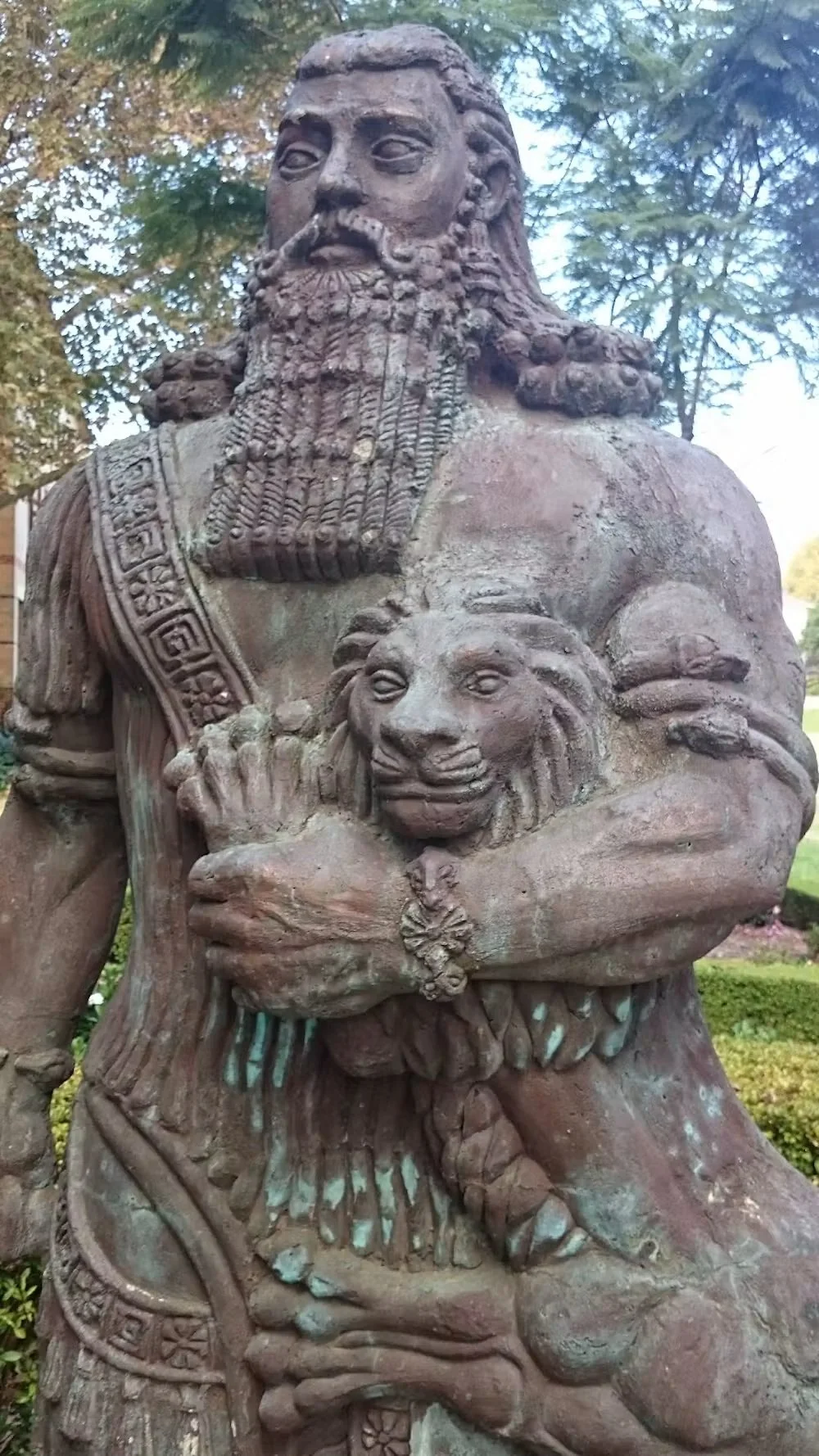
By Brandon Davis Jennings
Book four of Gilgamesh is a repetitive grind; it’s so monotonous that I wanted to put the book down forever. “At four hundred miles they stopped to eat,” the narrator tells us five separate times. Their journey surely crossed a variety of landscapes, but each leg the journey is described with the same words in the same order. Maybe it was to build tension or to make the journey feel tedious (as journeys often are). But mimesis isn’t always the best medicine for a story.
During this exhausting section of the epic, Gilgamesh and Enkidu are running to The Great Cedar Forest where Humbaba, the greatest evil of their age, resides. They ran another 600 miles before camping, and it took the two heroes three days and nights to cover that distance. The narrator informs us that such a journey would take regular men six weeks. That wasn’t the trip’s end, though. They still had 5000 miles to go.
The distance they traveled is less important to me than the fact that at the end of their run, they arrived at their planned destination, and when they returned home, and Uruk was constructed, they had reached the story’s end, but not its conclusion.
Plenty of stories have endings that aren't their conclusions. No one ever lives happily ever after. Gilgamesh, assuming he ever lived at all, died thousands of years ago, and if he was still alive, I doubt he’d be happy having survived all the horrifying things that have happened on earth since the time of his glory. But he did not, and so the story of Gilgamesh and Enkidu traveling together to defeat Humbaba, who’d terrorized their people since the dawn of time, ended when that demon lie dead. Humbaba’s death was the end of his story and the conclusion. Gilgamesh’s story ended with him as king; it concluded when he died, as all our stories will.
I know Gilgamesh is the book of interest here, but my buddy Manchin loved to talk about The Iliad and The Odyssey. Those poems had plenty of stories that concluded at their endings. Achilles’ story is the most famous. Locrian Ajax’s story concludes when his ship is sunk by a lightning bolt as punishment for raping Cassandra. Odysseus’ story ends when he reclaims Penelope and his home, but I don't know how it concluded. Telamonian Ajax’s story almost concludes in The Iliad, but a breath of life is added in The Odyssey when Odysseus meets Ajax in Hades, and Ajax refuses to talk to Odysseus. I guess if all those people are in Hades for eternity, their stories never concluded and never will.
I often wonder what Ajax would have said if he’d spoken to Odysseus, and I wonder what Odysseus would have replied. Of course there’s no way to know; it’s all made up anyway. There was no Ajax; there was no Odysseus. Regular people have always fought wars, and heroes were invented by regular people to inspire other regular people to perform great actions in trying times. The thing no one mentions in any of those epic poems is that the need for regular people to do extraordinary things never ceases. Times are always trying for someone, no matter how good those times are for everybody else.
Not enough focus on Gilgamesh, huh? I believe all of this is connected. Three gods of old washed the world’s filth away with floods. Enlil unleashed a flood in Gilgamesh, Zeus washed away all the Greeks save Deucalion and Pyrrha (they built an Ark), and then Noah and Naamah built an Ark and filled it with animals for Yahweh. I know almost nothing about Egyptian or ancient Chinese traditions, but I assume they have their floods too. If that’s so, five floods have washed the world clean—unless it was a single flood poured over the world by a single god that everyone was too self-centered to realize was trying to drown everyone regardless of where they were from or what they looked like.
Am I leaving someone out? Probably. I know nothing about the losers of wars long past, and there are wars that were never chronicled at all, so I don’t even know who won those wars. Whole civilizations have become nothing more than dust; others are lucky if their histories whisper to us in the way our clothing is stitched or how we pickle peppers or in the way we stack firewood—for which they’ll never get credit. I did not say “get the credit they deserve” because I didn’t mean they deserve it. They lost, after all, and it was not until recently that the people of the world made much of an effort to remember its losers.
Our world pushes us, and if we don’t push back, it will grind us into dust. That is what Gilgamesh taught me; that’s what it seemed to teach Manchin too. He said Humbaba had seven auras of protection, and then he told me that Ajax’s shield was made with seven hides.
“Do you think that’s a coincidence?” Manchin asked one night while we stared out at the purple tinted Arabian desert. Stars glittered above us in that infinite blackness. Did Humbaba stare down at us from some place in the sky?
“Humbaba was a monster,” Manchin said. “But he didn’t want to die, and he also wasn’t a monster because he chose to be. Someone created Humbaba. He just was what he was.”
What did Manchin mean? Humbaba was capable of reason, capable of manipulating people. Is that the difference between demons and scorpions? A demon is a demon so we should expect it to be evil, expect it to confuse us. A scorpion stings to survive; there’s nothing confusing about that.
Manchin and I didn’t talk about Humbaba or the conclusions and endings of epic poems in order to understand literature. We talked about these things because we were killing time in the desert between missions and because of a yellow dress we’d discovered outside the ruins of a Sunni mosque earlier that day. That desecrated holy place had once been a catholic church that was converted into a Shia mosque that was converted to a Sunni mosque. That was all the history of it that I learned. It's final transformation happened when it was mortared by some warlord because the Sunni Imam had encouraged women to read to their children so that the children would be exposed to books and ideas while they were young; it was a radical idea.
The yellow dress was draped over a cracked and bullet-riddled concrete wall. It was warm yellow, bright like the sun. The dress was clean, so it had not been there when the mortars fell. Someone had draped the dress over that wall in a delicate way. The fabric stayed clean, stayed smooth. It looked like a mother might have placed it there so that a child getting ready for school might put it on in the morning before heading to the kitchen to eat her oatmeal or whatever children in that part of the world eat for breakfast.
The dress had no size marking and no tag, but I could tell it was for a child. Someone had made this dress. That was common in that part of the world where people couldn’t order anything they might imagine from Amazon and have it delivered for free in two days or fewer. People made things they needed and wanted because that was the only way they could get them much of the time.
So there was the yellow dress, sunlight reflecting with such intensity that I had to squint to look at it directly. Who put it there and why? Manchin and I both wanted to know. It would’ve been remarkable if the wind had carried it there from some distant land, but that wasn’t possible. The dress had spaghetti straps, and that was completely unbelievable because it wouldn’t have been allowed, especially if women weren’t allowed to read to their children. From what I knew, it was anywhere from the ages nine to fifteen that girls had to start wearing the Hijab. This dress might have been acceptable in certain areas, but not where we found it.
Manchin said, “Do you think someone left it as a memorial for their daughter?”
“I wish I knew,” I said. But I didn’t know and still don’t. I grabbed it, folded it gently, and then put it in my footlocker when we made it back to the FOB the next morning.
I gave the dress to my daughter, Ariel, after that deployment. She still has it, and although it was ankle length when she was seven, it now hangs just below her mid thigh. She wears it to get her boyfriend’s attention, and as much as this is unrelated to the essay as a whole, I think it’s worth mentioning. Because this dress reached one end that was not its conclusion. Ariel will decide the fate of the dress next; that seems fitting to me.
There was something about the dress I’m embarrassed to admit, but this is the place to do it. Kaylynn encouraged me to write this to process things, and as disjointed as it is, I want to make sure she gets some insights she otherwise would not.
Years before we were at that obliterated mosque, wondering if Humbaba peered at us from behind the stars, we had been in that same desert. We were there with tanks and humvees and all manner of military vehicles because we were about to invade Iraq. That word invade, oddly enough, appears on none of my medals. There is no “Excellence in Invading” ribbon or “Invader’s Cross.” I don’t want those, but I want to acknowledge that we weren’t welcomed by everyone when we entered. That’s a fact. Some people did want our help. That’s a fact too. So no matter how many people are against it all today, they weren’t all against at the time, and here we are no matter what is said about the past in the present.
We reinforced our vehicles with steel from dead tanks, dead helicopters, dead artillery cannons. We stacked sand bags on the interior floors of humvees to ensure guys didn’t lose their asses, literally, when their vehicles ran over mines and, eventually, IEDS while driving in hostile territory. We installed pope glass for turret gunners so they weren’t exposed to enemy fire while scanning endless rows of date palms for weapons of mass destruction or soldiers or Fedayeen or Jihadists or Isis or drones or….
“This ain’t no crusade, boys.” That’s what the captain said before we bowed our heads for a prayer just before we started prepping the battlefield with thousands of rockets, mortars and tank rounds; saying it wasn’t a crusade was true as anything else I’d experienced related to religion at the time. During the build-up we’d raised hundreds of tents. It was a Tent City, and I’d sledgehammered countless rebar rods into the sand so we could tie the tents down. It was all very new to us, but I had the thought that maybe this was something that had happened thousands of times before. Maybe this place was desolate because it had been fought over since the beginning of time. And, as much as I wanted to believe we were doing the right thing, it was hard to believe that anyone would want us to help them to be in control of what I’d always imagined was an endless wasteland, akin to the vast void of space.
Iraq was not an endless wasteland, I soon learned. We passed marshes, wheat farms, barley farms, and the Tigris was lined with riparian vegetation. There was plenty of nothing, but there’s plenty of nothing in the Mojave Desert too. Iraq was not nothing as far as the eye could see, you know? It depended on where you stopped and looked. So we riveted and bolted metal to the vehicles to make them safer because the more we saw the more we understood what people were trying to protect. Iraq was a place worth dying for.
A few days before the invasion, I got a package. Inside were two things made of construction paper, duct tape, and dowel rods. I could tell immediately what they were modeled after. I wore one. Ariel made flak vests for Manchin and me. Every man I deployed with had a flak vest. Special forces always got the best gear first. It was a perk of the job, but it was also a necessity because we were always headed into the worst places, and in those places, people got hit with shrapnel and bullets more often than people working in the finance tent. I will say that if people didn’t get paid on time, the finance tent would’ve been a very dangerous place to be.
But what a beautiful thing my daughter did for Manchin and me. I never mentioned it to Kaylynn or Ariel when I got home. I’m not sure if they remember making those things.
That day Manchin looked at the paper vests and asked, “Who’s the other one for?”
From the box I grabbed a cut-out pink paper heart with a note scribbled on it and read:
We made these for you and Uncle Chinny. Don’t get hurt, Daddy.
Come home soon.
I love you,
Ariel and Mommy
I handed one to Manchin, and he said, “My God you’ve got a good girl there.”
I packed my paper flak vest into my foot locker because, if I’d have worn it, it would have soaked through with sweat immediately. That was one constant: sweat-soaked undershirts sucked tight to my chest and back. Salt stains ringed the armpits of every undershirt I owned at each deployment’s end; I tossed them all in the trash after each deployment on my way to the C-130, hoping that act might help me forget some of the things I’d seen and done while wearing those shirts. I don’t know what I did with the paper flak vest. It was probably thrown away too.
Ariel mailed the flak vests a couple years before we found that yellow dress outside the crumbled mosque. She mailed them after surviving a school shooting that her best friend and their kindergarten teacher did not. That all happened before I’d learned Islam had more than one sect. Why I didn’t assume Islam would be fractured like all other religions is a mystery to me. Maybe my brain needed Islam to be unified so we’d have a single enemy, clearly defined, like the enemy seemed to be in world war two. But we did not have a clear enemy, and we weren’t on a crusade, like I said. This war was about Saddam Hussein doing bad things to people who couldn’t protect themselves. It was a secular war against a tyrant, and some of the people involved just happened to be religious. I wasn’t, but I was just one guy. I could not and did not want to speak for everyone. I was just doing my job. I was in a war zone, and my daughter was safe at home. She’d survived a school shooting, and was so concerned about my safety that she mailed paper flak vests to protect Manchin and me. No one told me about the shooting until I was back from that deployment. Kaylynn was right to keep it from me. If I’d been distracted by that, I might have got myself or Manchin killed. We were supposed to be over there making the world safer for everyone, and my own hometown was so broken that a teenage boy snapped and took it out on kids and a teacher in the same school where he’d once been a student. His dad was a Desert Storm veteran who hanged himself the year before; I didn’t know that until I looked the kid up, while trying my best to understand his motivations without becoming blinded by rage.
*
I know this essay about Gilgamesh has all fallen apart, but there’s little I can do to organize my thoughts in a way that makes this work any better than it’s working; if it is working at all. But when we were out there in the desert two years after Dubya told us “Mission Accomplished”, I was aware of what had happened at Ariel’s school. I was aware of the complexities of Islam. I was aware of Hadiths and Imams and of the poor Christians and Yazidis and liberal Muslims who were getting slaughtered when warlords rolled into towns that had been havens to people of varied religions for hundreds of years because there was no longer anyone there to protect them. I was aware that the mission was not accomplished.
And there I stood in the oppressive heat of the Arabian Desert, looking at that yellow dress that gleamed in the sunlight. I walked over, picked it up by the collar to let it hang and see how long it was, to make sure it really was in perfect condition. I traced the stitching with a gloved forefinger; the craftsmanship was impressive. Whoever made the dress really knew what she was doing, I thought, even though I knew and know nothing about making a dress. I’m not sure why I believed a woman had made it, but I did. For a moment while it dangled from my hand, I thought, maybe, the dress had been placed there by a god, and maybe if I brought this dress home and gave it to Ariel, she’d be protected from the ugly things at home that I might not be there to stop. Maybe the dress was magical, divine. Maybe draping it over Ariel would be like when Thetis dipped Achilles in the river Styx, or like Ajax’s shield, or Humbaba’s seven auras, if they had actually protected him. I could protect Ariel almost completely with this dress. She’d have to choose how she used the protection: fight for glory, die and be remembered forever, or live a long, full life at home, and die in obscurity.
I told Manchin about this idea, and he said, “I think that makes sense, man.”
I said, “I should probably just put her in Jiu Jitsu.”
I brought the dress home and gave it to Ariel. She loved it so much she wore it for a week straight. I never slept that good before or since. All the guys were still alive then.
A couple years after I’d brought the dress home, I spent an evening at Manchin’s house. It was the last time we talked before he drowned in a training exercise somewhere near San Diego. He and I sipped Penelope bourbon from lowball glasses while we talked about cutting the grass, about how these idiotic wars wouldn’t end no matter how many times we did our jobs perfectly, and I talked about how I didn’t understand why we survived so many times while so many other people didn’t survive a single deployment.
“Well,” Manchin said. “I understand that.”
“Oh?”
He stood from his recliner, and walked to his gun safe. He opened the door, and I saw, duct taped on the cabinet’s back wall, the flak vest Ariel had made him.
I laughed. “Maybe that is it.”
“I’m serious, Vez.”
“I know,” I said. I looked at his weapons placed neatly in the safe: Mossberger 12-gauge, Ruger AR-556, a rust and grime covered Kalashnikov he’d smuggled home from Afghanistan, and a nine millimeter that seemed out of place. “You hand over your balls for that Lady Smith?”
He smiled and then said, “You know I never had any."
Now Manchin’s dead, and I’m trying to write about Gilgamesh, floods, ancient Greece, gods, and magical dresses. I see the end, but somehow it feels all wrong. This is supposed to be about Gilgamesh, so I should focus on that text or else it’s doomed to fail to be what I declared it was. Is there a worse failure than that: to set out on a clear mission, to state your goal, and then never arrive? Is it worse to change the goal in the middle of the mission? How do we get where we’re going if the place we’re headed doesn’t exist? Maybe we stop moving and build that place right where we are? Gilgamesh built Uruk where he was, built it so it was unequalled by any other city. He built Uruk for himself and all who stood with him. He created the space for his people to thrive and they did.
How does this all connect? Should I let Kaylynn decide? She asked me to write this, so she can be the judge or Ariel can. Everyone who reads an essay is the essay’s judge, though. Maybe Kaylynn and Ariel will disagree. Manchin and the rest of the guys can’t read the essay, and I can’t cross the river Styx or the vast oceans and the waters of death. The river Styx is uncrossable because it’s not real, and Gilgamesh’s waters of death are none of the oceans that I’ve crossed scores of times.
If those bodies of water were real, then I’d like to think I’d be brave enough to cross them in search of my friends, to try and talk to them again, to try and ask them about things that mattered to them outside of their lives in the military. I want to really know them, but the time to learn who they are is lost. Maybe why this is about Gilgamesh is because, just like him, I want to be outside the great cedar forest with my friends, all of us standing together. Back when we have an enemy in sight: a demon. We know the demon will confuse us because it is in the demon’s nature. But still we know where we’re going, and we know what we have to do when we arrive. It will be the end when the battle is done, and we hope to God it will also be war’s conclusion.
Some nights I stare out at the woods from my back porch and I can imagine, in the meniscus where the two great hills just beyond my property line meet, my friends all standing, staring into the dark woods beyond. That image is a mnemonic device for me; it helps me recall these words from Gilgamesh: “They stood at the edge of the cedar forest, gazing, silent.” Those words aren’t meant just for Gilgamesh and Enkidu. Those words are mine and Manchin’s words and the words of everyone I’ve ever served with or fought against. But the final words of that section of the great Mesopotamian epic are mine and mine alone because I'm the one left to speak them, because my end was not my conclusion, and God I want these words to be true for myself and for every person dying to speak them. So here they are: There was nothing to say.
****
Brandon Davis Jennings is a writer, artist, and Air Force veteran of Operation Iraqi Freedom. He is the author of Operation Iraqi Freedom Is My Fault and Battle Rattle and Other Stories. Born in Virginia and now living in Indiana, his fiction explores memory, war, family, and the stories people tell to make sense of loss.