
From Elvis
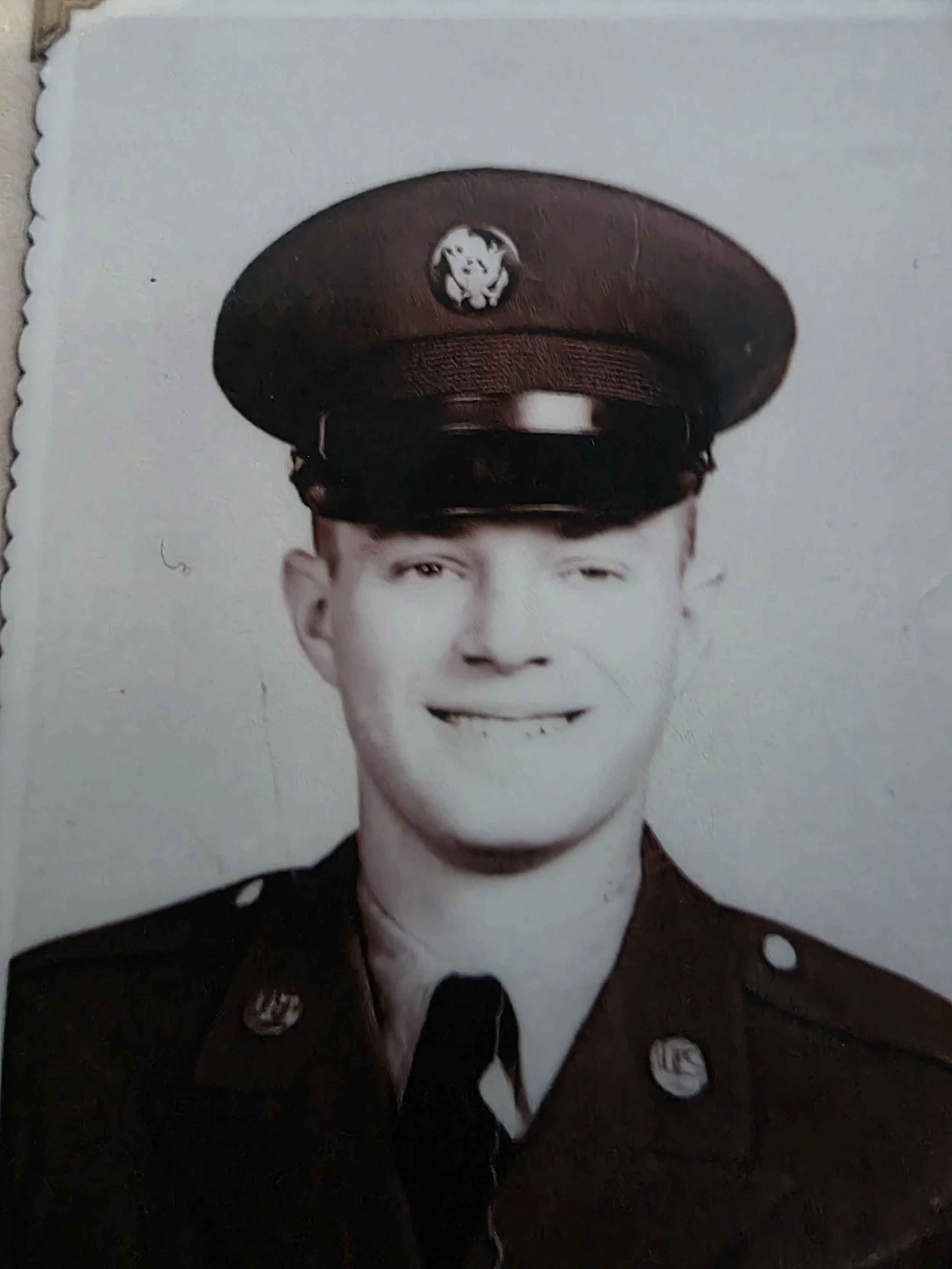
By Michael J. Brown
Prologue
I was six years old, in my bedroom sorting baseball cards, when he called me outside. An older version of him stood in the yard. My father introduced him as "an Army buddy," and said — with a pride I didn't often see from him — that I knew everything about baseball. The man turned to me and started asking questions. "You know who the White Sox shortstop is?" "Luis Aparicio," I said eagerly. "You know where he's from?" "Venezuela!" He shook his head. "Puerto Rico." I felt shame, like I let my father down, but I was sure of Venezuela.
I went back inside. I found the card. Venezuela, it said.
I looked out the window at the pair of them. My father seemed smaller somehow, talking to the man. I never told my dad about Venezuela.
I sometimes wondered about the man and if what he said hurt my father or my standing in his eyes.
Only much later did my mother tell me that the man was my grandfather. His mother had forbidden it. He obeyed her to the end.
—
Ted walks past his mother making dinner, to the living room where his stepfather sat in his chair reading the Milwaukee Journal. He needed a new notebook for school and asked his stepfather for the needed pennies.
The words “time you began to earn your keep” echo in Ted’s mind. He looks past his stepfather, to his sister playing in her room. He walks away. He would do what needed to be done. The stairs creak as he heads to the blackness of his room in the attic.
The Ride
When I was small, my father took me to work on Saturday mornings. He'd started in the produce section at twelve, and I rode on the bottom of his cart while he moved between the storage room and the floor. I was probably more hindrance than help, but he let me carry what I could manage to the display while he arranged the rest. When we finished, he took me to the bakery counter and the woman there gave me a cookie, still warm.
I didn't know until I was grown that he'd won an award once for one of those displays. He never mentioned it.
He never mentioned a lot of things.
His own father had never taken him anywhere like that. Neither had his stepfather. I didn't know that then either. I just knew I was happy, riding low to the ground on a Saturday morning, doing work that mattered because he said it did.
–
The train pulled west out of Milwaukee in the early morning, steel wheels settling into a steady rhythm as the city thinned and gave way to open ground. Ted sat by the window, coat folded across his lap, hands resting where they had nowhere else to go. Around him, other young men filled the car in uneven clusters — some quiet, some talking too loudly — all of them moving in the same direction without yet knowing what that meant.
By afternoon the sky widened, the land flattening further as if it were being prepared for something. The train stopped briefly in small stations, doors opening onto cold platforms and unfamiliar names. Men stepped off and others replaced them. Ted stayed where he was, the motion of the train doing the work of decision for him.
Night came quietly. The window darkened, turning reflective, and Ted’s face looked back at him, older than it had felt only weeks before. He thought of his father — a man spoken of only in fragments, who had left and never properly returned. He wondered, as he often did when alone, whether that man had once ridden a train like this, headed somewhere, with the same mixture of resolve and unease. The question had no shape, no answer, only a persistent pull. He knew little of his father’s past, but he did serve in the military. Did he train at Fort Carson too? His thoughts shifted, as they did now, to his wife. Married only weeks before, the memory of the ceremony already felt compressed — a blur of faces, borrowed suits, quick photographs. He had left her standing at the train station, flanked by his mother and stepfather, as the day moved forward without him. The train carried that image west as steadily as it carried his body.
Sometime before dawn, the rhythm changed. The air felt thinner, sharper. When the light returned, the land rose and folded, the distant outline of mountains appearing along the horizon — solid, immovable, unlike anything he had known. Ted straightened in his seat, watching them come into clearer view.
By the time the train slowed near Colorado Springs, the past had settled into something quieter. Ahead lay Fort Carson — unnamed yet, but already present — and the work of becoming something else was about to begin.
He filed out with the others, scanning the platform for the bus that would carry him the rest of the way. An Army-green vehicle idled near the curb, Fort Carson stenciled above the wide front window. A grizzled soldier sat behind the wheel, cap pulled low. Nearby, another soldier stood with a clipboard, checking off names and snapping short commands at the fresh faces gathering in front of him.
Ted stepped forward when his turn came. When the soldier looked up, Ted said, “Brown, Theodore H,” in the same flat manner he had heard from the others.
“Brown. Check. Get on the bus.”
Ted sat near the back, jacket buttoned tight against the chill, hands folded empty in his lap. Outside, muted stretches of pine, scrub, and open ground passed in a slow blur, occasionally punctuated by the faint glow of a distant farmhouse. Around him, voices stayed low and clipped, a shared hum of uncertainty filling the narrow space.
As the bus turned off the main road, chain-link fences and distant guard towers came into view. Patches of pine and scrub bordered wide stretches of asphalt, the air carrying a mix of damp earth, engine oil, and the faint tang of disinfectant. Then the barracks appeared—long, solid rows of red brick, their windows catching the dull glow of streetlights. Ted straightened in his seat, shoulders tense, eyes moving across the parade grounds, the neatly mown grass, the precise geometry of the post.
Everything had changed, yet nothing had truly begun. The world he had known slipped away with each turn of the wheels. Fort Carson was unfamiliar and waiting.
Fort Carson
I found the box in the back of the closet, the kind meant to be permanent and forgotten. Inside were things my father had kept without explanation: folded papers, a set of dog tags, photographs without dates. As I sorted through them, I tried to imagine him at eighteen, stepping off a train in Colorado, carrying nothing but what he had been allowed. I could not picture it clearly. I never could.
“Brown!”
Intake began without ceremony. Ted stood in line as orders moved down the row faster than he could follow, his name stripped to a surname, his questions left unasked. Men stepped forward when told, stepped back when corrected, the line advancing in small, obedient increments.
He surrendered what little he carried. Pockets were emptied, items examined and set aside without comment. Papers changed hands. Forms were stamped. Instructions were given once and not repeated. Ted learned quickly to watch the man ahead of him, to anticipate the motion required, to keep his eyes forward.
The barber worked without conversation. Ted sat as the clippers moved across his scalp, dark strands falling to the floor in uneven clumps. The mirror offered only a brief, unfinished reflection before he was waved on. The man looking back at him appeared sharper, more exposed, already altered in ways he did not yet understand.
Uniforms were issued in a long, echoing room that smelled of canvas and bleach. Sizes were approximate. Sleeves ran long, collars stiff against his neck. Boots were heavier than he expected, their leather unyielding, their laces still unbroken. He was told what belonged to him now and what did not. Everything else was the Army’s concern.
Time compressed. Meals were eaten quickly, conversation discouraged. Ted learned the cadence of commands, the way voices carried authority without explanation. He learned where to stand, how to move, when silence was required. By evening, exhaustion settled in not as fatigue but as a dull acceptance, a sense that resistance had already been outpaced.
The barracks were long and spare, rows of metal bunk beds aligned with practiced precision. Ted stowed his issued gear where he was told and sat on the edge of his bunk. Lights went out at the same moment throughout the room. In the sudden dark, the sounds of the post carried through the open space: footsteps on gravel, a distant voice calling orders, the wind pressing against the building. Ted lay awake on the lower bunk, staring up at the dark shape of the mattress above him. Beyond it, the ceiling dissolved into black. The frame creaked softly as the man above shifted, the sound unfamiliar and close. Somewhere beyond the barracks, the mountains stood in silence.
The next morning, Ted moved with the line along the perimeter. His boots scuffed the asphalt, leather still stiff, the sound carrying farther than he expected. Spacing mattered. He watched the man ahead of him and adjusted his pace, learning the rhythm by imitation. A voice corrected him once—not raised, not repeated—and he changed course without comment.
He became aware of being watched without knowing by whom. Posture was noted. A hand left too long in a pocket was corrected. A collar was straightened by someone other than the man wearing it. Instructions came quickly and were not explained. Compliance mattered more than understanding.
Ted shifted the weight of his pack and squared his shoulders. He listened closely, storing the cadence of commands, the brief pauses that signaled when to move. He learned to read glances, to anticipate direction before it was given. There was no room for hesitation.
By evening, the frost had melted, and the barracks smelled of damp wool and oil. Ted lay on his lower bunk, the ceiling above blocked by the upper mattress, the darkness pressing close. Outside, the mountains stood distant and silent. In the quiet that followed the day’s work, the whistle of a distant bugle drifted through the pines, mingling with the faint tang of wood and cleaning supplies. Each sound, each smell, became as familiar as any drill.
Fort Carson was not cruel, exactly, but it was exacting. Each day was measured, each task deliberate. For Ted, it was a place that reshaped the body and reordered the hours, where small actions were noted and small details carried weight, and where the ordinary became extraordinary simply by being noticed. In a few weeks, he would leave this training ground for Germany. The thought carried no weight yet — only the faint recognition that something larger awaited beyond these fences.
Germany
Growing up, when I asked about the Army, my father gave me facts. Where he’d been. How long. When he got out. He never volunteered stories. Never framed anything as important.
Once, I asked if he’d liked it.
He thought for a moment.
“It taught me how to do what needed doing.”
That was all.
–
The mornings came early in Germany, damp with fog that lingered over the parade grounds. Ted moved with the practiced ease of someone who had learned to carry both his pack and his thoughts. Days were spent walking between barracks, kitchens, and drill fields, each footstep measured, each interaction polite but brief.
That morning, frost still clung to the edges of the parade ground. Ted climbed into the 3/4-ton utility truck, hands stiff in his gloves, boots pressed against pedals that hadn't yet warmed. The instructor's voice came clipped and flat: "Controlled stop. Defensive maneuver. Winter course."
A few vehicles ahead, a recruit overcorrected on a slick patch. The back wheels broke loose. The truck fishtailed once, then again, and slid hard into the shallow ditch at the edge of the yard. Wood cracked. Metal scraped. A shout rose above the engine's groan.
Ted was out of his cab before he'd decided to move. He crossed the icy ground at a careful run, reached the driver's door, and pulled it open. The recruit inside was shaken but whole — hands gripping the wheel, eyes wide, not yet sure what had happened. Ted got a hand under his arm and talked him out of the cab, low and steady, the way you'd talk someone back from the edge of something.
No one had told him to do it. No one had told him not to.
He filed back into line without comment. The instructor's eyes followed him briefly, then moved on. It needed doing. That was enough.
The Incident
Years later, sitting across from him at a kitchen table that had already seen better days, I noticed the silences more. He drank his coffee black. He listened more than he spoke. When he did speak, it was about work, or the weather, or nothing that needed answering.
Sometimes his attention drifted.
It wasn’t the look of a man remembering glory. It was something quieter—his eyes fixed on nothing, his hands still, as if he were listening for a sound no one else could hear. Wind, maybe. Or boots on frozen ground.
I didn’t know then.
–
Winter came early that year, settling over the training grounds with a quiet insistence. Snow moved in overnight, softening the ridgelines and erasing paths the men had followed only hours before. A maneuver stretched longer than planned. Orders shifted. By the time the unit pressed forward, Ted and three others were no longer in step with the line.
At first, the cold was manageable. It settled into gloves and boots, a dull ache that could be ignored. As the light thinned, it sharpened. Fingers stiffened. Breath grew louder, more deliberate. Snow worked its way into seams and folds, melting and refreezing. No one spoke much. There was nothing useful to say.
Ted took stock without naming it as such. The slope offered a shallow cut from the wind. Packs held more weight than comfort, but there were things to be done. He got out his entrenching tool, broke the crusted snow to make space to sit without sinking. He directed the others close, layered clothing where it mattered. For shelter, he worked the branches into place with the E-tool and his bayonet. Movement became careful, economical. Nothing wasted.
Time loosened. Night pressed in. The cold gnawed steadily, patient. Ted rationed what little they had, not from calculation but habit — the quiet knowledge of how long things must last when there is no certainty of relief. He stayed awake longer than the others, shifting when numbness threatened, watching breath rise and fade in the dark. When one slowed, he moved closer.
By morning, the world had gone pale and still. When they were found, the voices came as if from a distance. Hands pulled them upright, wrapped them in heavier coats. Someone laughed once, sharply, then stopped. No one spoke of what might have happened.
Ted sat in the back of the transport, boots thawing too fast, fingers burning as sensation returned. The truck’s heater rattled and hummed. He heard his name mentioned by the others. He watched the road slide past, the white fields breaking into dark lines of fence and trees. The work was finished. What remained was the body, slow to catch up, and the quiet understanding that something had shifted, though he could not yet say how.
The Hospital
I was 18 that August, explaining to my father that I couldn't join the army because of my asthma. The announcement came over the radio - Elvis had died - and I watched my father's face stay still, his eyes shifting to somewhere else, far away. Something turning over in him that he never named. I thought I had disappointed him - I left it alone.
–
The ward settled as the afternoon wore down. Footsteps moved farther apart. Voices dropped. Ted sat on his cot and worked feeling back into his fingers, pressing his hands together until the numbness eased. Outside, weak winter light pressed against the frosted windows.
Across the aisle, a young soldier lay propped on pillows. His face was pale, his jaw tight with fever. Earlier, several men had stood around his bed, lingering longer than regulation allowed, but now he was alone.
Ted got up, paused at the edge of his cot, then crossed the aisle. “You alright?” he asked.
“Tonsils,” the soldier said. His voice was rough but steady. “Fever.”
Ted nodded. He started back, then paused. “Had a crowd earlier.”
The soldier gave a small shrug. “Just the guys. They worry.”
There was nothing practiced in the answer. No effort to impress or deflect. Ted took it at face value.
“Get some rest,” he said.
The soldier nodded once.
That night, Ted lay awake longer than usual. Soldiers didn’t gather like that without cause. Not unless a man had done something that mattered.
Morning came thin and gray. Medics moved down the ward with charts tucked under their arms.
“…all this over tonsillitis,” one said.
“Didn’t want special treatment,” another replied. “Told them to leave him alone.”
They stopped at the bed across from Ted.
“Presley,” one said. “Elvis Presley. Fever’s down.”
Ted looked again at the young soldier. The name was familiar, though he couldn’t place it. The man lowered his eyes, uncomfortable with being discussed.
“You’re Elvis Presley?” Ted asked.
“Yes, sir,” he said. “But I’m just Specialist Presley here.”
With a slight smile, Ted said, “I’m no ‘sir’, just PFC Brown. But that explains the visitors.”
Presley nodded. “Didn’t ask for it.”
Ted studied him for a moment. No swagger. No edge. Just a tired soldier waiting to get well.
“You seem squared away,” Ted said. “That’s enough.”
Presley looked up then, surprised. “Thank you.”
Later, when the ward quieted again, Presley reached into his footlocker and held out a small envelope.
“I’d like you to have this.”
Ted shook his head. “You don’t need to.”
“I want to.”
Inside was a photograph: Presley and his mother, standing outside a small house. Nothing posed.
Ted slid it back into the envelope and put it in his pocket. “I’ll keep it safe.”
By afternoon, Ted was cleared to leave. He shouldered his bag and paused once more at the foot of the bed.
“Take care,” he said.
“You too, sir, I mean, PFC Brown.”
Ted nodded, smiled and walked out.
Down the hall, a radio came on. A voice announced a song. The name meant something to the world.
To Ted, it was just another soldier in a hospital ward.
Discharge
Winter loosened its hold inch by inch. Snow receded from the edges of the post, leaving behind damp ground and bare patches that caught the sun. Ted finished his last weeks quietly—packing, turning in gear, standing where he was told to stand. The Army did not mark endings with ceremony unless required.
The medal came on a cold morning, issued with the same precision as any other order. A short formation. Names read aloud. A citation spoken flatly, stripped of drama. A man stepped forward, pinned the ribbon, and shook Ted’s hand once. No speech followed. The formation was dismissed.
Ted felt the weight of it settle only after—metal against wool, small but undeniable. It marked a night on a ridge, a stretch of hours where cold and judgment had mattered more than rank. He did not think of it as bravery. He thought of hands, numb and stiff, working because they had to.
He folded the citation carefully and placed it with his papers. The medal went into his bag.
Discharge followed soon after. Signatures. Stamps. Final instructions delivered without ceremony. When it was done, he stood for a moment outside the building, duffel at his feet, unsure what to do with the sudden absence of structure. Then he picked it up and moved on.
He left Germany as he had entered it—quietly.
Later, when the uniform was folded away and the Army reduced to documents and habits that lingered longer than expected, certain moments remained close: the sound of wind on a ridge, the feel of frozen ground through gloves, a hospital ward settling into silence, a young soldier who asked only to be treated like any other.
They were not stories he told. They were simply things he carried.
That summer, my mother was living with her parents, in the upper flat of a duplex. She heard someone at the door and went to answer it carrying me, her newborn son. He was already sitting at the kitchen table when she came in.
“I’m home,” he said, as if that explained everything.
Some men come home carrying responsibility.
And some carry memory like weight, distributed so carefully it never shows.
I don’t remember that day. I only know it from the way it was told.
The Visit
My mother called me to tell me the news: my father was diagnosed with dementia. I had to see him. The next Saturday, I made the long drive from Illinois, thinking about how the distance between us could be measured in things other than miles.
The driveway was cleared when I arrived. The neat edges, the clean lines — it looked like him. Inside, I heard his familiar footsteps in the basement. I followed the sound.
He looked up from his workbench, hands still working on something I couldn’t see, “Ah, Doc Holiday, what are you doing in town?”
Something tightened in me. I hadn’t heard that nickname in over 20 years. “Cold outside, I see you cleared the driveway.”
He cocked his head for a moment, as if listening for something just out of reach, “Cold?” he repeated. “Did I ever tell you about when I was in the Army and…”
His voice thinned, then stopped altogether.
He looked past me, as if the memory was out there, somewhere, waiting.
I waited with him, the way I always had, wishing I could reach the memory he couldn’t.
Softly, almost to myself, I answered,“No, you never did.”
Discovery
My father passed away and I was given a box of his things, a box that had been moved too many times—basements, closets, garages. The kind of box that collects lives in layers. Papers. Old letters. A medal wrapped carefully in cloth. The accompanying citation. A military hospital record.
I had it open on the table when the radio caught me. An Elvis song — one of the early ones. I stopped what I was doing.
I thought back to the day Elvis died. I looked down at what was in my hands.
An envelope so thin and weightless that at first I thought it was empty. I opened it. Inside was a black-and-white photograph, faded with age: a young man standing beside his mother, both of them smiling at the camera. He looked familiar in a way that took a second to place—not because of fame, but because of posture. The way he stood. The way his smile held back. I turned it over.
Written in my father’s block handwriting. “From Elvis”.
For a long time, I just held it. I thought of my father, of his faraway look that day in August when the radio told us of the passing of an icon.
Only later did I understand why it had been kept, and why it had never been mentioned.
I walked to my desk and opened the middle drawer. I looked at the baseball card sitting there and placed the photograph on top of it.
Author’s Note:
This is a work of historical fiction. While drawn from family stories and military records, some dialogue, interior thoughts, and details have been imagined or reconstructed for dramatic effect.
****
Michael J. Brown is the son of a U.S. Army veteran. His fiction and essays explore memory, family history, military life, and the silences that shape what is passed from one generation to the next. His story “From Elvis” is drawn from family stories, military records, and the artifacts his father left behind.